The Blueprint of the 66 Books of the Holy Bible
Examining how divine order structures,
transforming a seemingly fragmented library into a seamless masterwork.
Not a Collection of Random Documents
If you have ever examined the sixty-six books of the Holy Bible casually, it is easy to view them as an anthology of ancient religious texts written by dozens of different authors across fifteen centuries. On the surface, one might perceive disparate historical records, poetic odes, prophetic warnings, and moral epistles assembled together loosely by historical tradition.
However, when we apply an engineering mindset (analyzing systematic design patterns, and cross-referential interlocks) a breathtaking reality comes into sharp focus. The Bible is not a collection of random documents; it is a meticulously engineered architectural masterpiece designed with absolute precision.
📖 I. The Structural Symmetry of the Canon
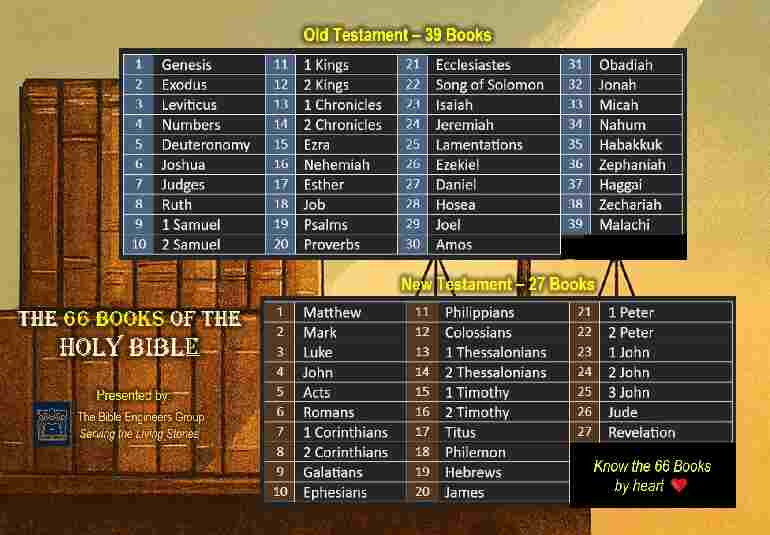
Consider the macro-structure of the canon itself. Just as a massive suspension bridge requires exact counterweights and supporting pylons, the biblical framework is divided into perfectly balanced modular divisions:
- The Pentateuch (The Foundation): The first five books lay the baseline physics of creation, law, failure, and covenant promise.
- The Historical Books (The Framework): Twelve books mapping the national erection, structural tests, and eventual collapse of Israel under covenant conditions.
- The Poetic & Wisdom Books (The Interior Design): Five books articulating the human interface—heart posture, suffering, worship, and ethical mechanics.
- The Prophetic Books (The Stress Analysis): Seventeen books issuing structural diagnostics, warning of foundational fractures, and forecasting the ultimate restoration.
- The New Testament (The Superstructure): Gospels, Acts, Epistles, and Revelation completing the terminal phase of God's redemptive plan through Christ.
Figure 1: The systematic unity and framework linking the Old and New Testaments.
"Every historical milestone, covenant, and prophetic promise finds its ultimate convergence and structural integrity in the person and finished work of Jesus Christ."
— The Bible Engineer's AxiomII. Load-Bearing Prophecies and Types
In structural engineering, a load-bearing column transfers weight safely from the upper floors down to the bedrock foundation. In Scripture, types and shadows in the Old Testament act as preliminary load-bearing columns.
The Passover lamb in Exodus, the bronze serpent in the wilderness, and the sacrificial system prescribed in Leviticus do not stand independently. They are engineered components designed to bear the theological weight until the ultimate reality—Jesus Christ, the Lamb slain from the foundation of the world—arrives to lock the entire structure into place.
III. Conclusion: Entering the Blueprint
When we view Scripture through this rigorous, unified lens, confusion gives way to awe. The Bible ceases to be an intimidating library and becomes a magnificent, coherent blueprint of redemption. As truth seekers and Bible Engineers, our task is not to rewrite or question the Master Engineer, but to study His plans, verify His precision, and anchor our lives in His unchanging design.